Monday, May 30, 2016

My Passion for Pastel


Over the years, I’ve dabbled in all sorts of media: pencil, charcoal, silverpoint, watercolor, gouache, oil, etching, monotype, serigraph, acrylic… you name it, I’ve tried it. When I began to take plein air painting seriously, I started working in oils almost exclusively. It takes a lot of effort to become even slightly adept at painting outdoors.  It made sense to focus on one medium and get comfortable using it.
Jennifer L. Hoffman, Lyric, pastel on
paper, c. 2005.

Despite that conviction, after looking at some Degas pastel sketches at the Denver Art Museum, I’d bought a box of 30 pastel half-sticks on sale at an art supply store.  I didn’t have a specific plan for using them, but after they sat on the shelf in my studio for a while, they began to catch my eye.  I felt an increasing itch to try them out.  Just for fun. Though it’s been over 10 years, the day I finally gave into that urge is surprisingly clear in my mind.  It was spring, and I went outside to cut serviceberry blossoms and mountain bluebells.  I put a few sprigs into a small green jar, set them on a white tablecloth, and pulled the untouched box of pastels off the shelfNot having an ideal place to set up for pastels, I pulled out a piece of gray Canson paper and a drawing board, sat cross-legged on the floor, and started working.  I recall being instantly engrossed in the process.  Time simultaneously stood still and passed in the blink of an eye.  It was a bit like falling in love.  I knew from the moment I finished that still life that I would never stop using pastels.

Since I was a child, I have loved to draw. Most exciting for me, when I first dragged a pastel across that sheet of paper, were the similarities to both drawing and painting.  My hand was in contact with the surface of the paper.  The pastel stick responded to even the slightest pressure changes.  I could make lines and gestural marks.  There was no drying time – no waiting to apply the next layer.  But I could also quickly cover large swaths of paper with masses of color.  The color was opaque.  I could layer colors to create new ones, create texture, build impasto.  I could blend or not blend.
Details of color layering and blending with pastels.
Jen using pastels in the field.
Color mixing in pastel is a magnificent thing.  Unlike liquid paints, pastel colors can’t be mixed to order on a palette.  I have to create the right colors on the painting.  Most pastelists have huge pastel palettes with every color and value you can imagine.  But even then, the perfect color can elude us.  Pastelists get to employ something wonderful called visual color mixing, which involves putting down layers of color without blending them so the colors vibrate and react with each other on the surface.  For example, from a distance, a field of grass may appear to be a warm green, but when you get up close to the painting, you will see a variety of oranges, greens, maybe even yellows and violets all applied together to the surface.  The effect creates something that mimics the textures of nature and the vibration of light that we experience when we’re out in nature.   

And because there is no time-consuming color mixing involved, I love to use pastels in the field.  As a plein air enthusiast, I often am painting in quickly changing conditions.  Being able to figure out my composition and get straight to work allows me to react more immediately to the experience.  It also allows me to grab a thought, a feeling, a fleeting moment of light in just a few minutes – to record it on paper and in my mind so that I can access it later.  Pastels are the perfect medium for me to record a visual memory. 
Jennifer L. Hoffman, Thermal Spectrum, pastel on mounted
paper, 11x14 in., 2016.
Mary Cassatt (1844 –1926), The Pink Sash 
(Ellen Mary Cassatt), c. 1898, Pastel on paper, 24 x 19 ¾ in
Some of my favorite artists, both historical and contemporary, have also had love affairs with pastels.  William Merritt Chase, Childe Hassam, Dwight Tryon, James Abbott McNeill Whistler, John Twachtman, Edgar Degas, and of course Mary Cassatt were all avid pastelists.  One of my favorite examples of the power and subtlety of the medium resides right here in Wyoming, at the National Museum of Wildlife Art.  Titled King of the Forest by Rosa Bonheur, it is 5 feet high and nearly 4 feet across, a stunning pastel on linen. 
Jennifer L. Hoffman, Gradient, pastel on mounted paper,
10x6 in., 2016.
Today, artists like Wolf Kahn, Ellen Eagle, Mario Robinson, Denise LaRue Mahlke, Skip Whitcomb, Bill Cone, and Casey Klahn (among many others) all use this medium to create diverse, expressive, meditative works that inspire me to keep pushing and experimenting.

But most of all, pastel has helped me access something deeper and more personal.  By using the most ephemeral of media - sticks of colorful dust - to create a lasting image, I make a fragile, enduring mark.  In that way, pastel is a bit like magic, a bit like music, a bit like poetry, and a lot like us.


 Behind the Brushes 
"My Passion for Pastel"
Trio Fine Art

Thursday, April 28, 2016

The pleine air painting and a question from Pope Julius II

Is it finished?

The story is told that when Michelangelo was painting the ceiling of the Sistine Chapel, Pope Julius II would look up and shout to him "When will you be done?," and Michelangelo would shout back "When it is finished!" Of course they were talking about physically finishing the paintings of the entire ceiling and not just one particular segment. This, admittedly is a round about way of taking us to pleine air painting and the question of when it is finished. Pleine air painting poses a very different question of when a work is finished versus a studio painting, of course, because of time constraints. One could argue that this statement is not true, as finished means finished no matter where the painting takes place. I will be truthful and tell you that most of my paintings are not alla prima and require some work in the studio to be "presentable." Occasionally, I come upon a scene that is so perfect for pleine air work that I can figuratively paint it before I paint it. These paintings do not need a single stroke after the work out of doors.  For me, this is rare but it does happen.

This is an alla prima piece measuring 20 x 16
The question is, "How do you know when the painting is complete?" The answer lies in another question, "Does your picture represent all that you wished to say of the scene before you?" We know that something can always be added to a painting to "finish" it. We think that we need more detail, some color correction, maybe some composition rearrangement, more design elements, softening of edges, nicer brushstrokes, and so forth. It is at this point that we should lay the brushes down and take a closer look at the painting. What do I mean by a closer look? Analyze the scene before you and revisit your inspiration for choosing it to paint. What was it that made you want to express your feelings in the painting? Was it the mood or the particular subject or the raw emotion? How could you best capture these feelings in paint? Do you still see these emotions in your painting up to this point? Does something else need to be added to express your emotion more fully? I speak for myself when I say that I have ruined many pleine air paintings by answering these questions incorrectly. Sometimes the rather rough appearance of a two-hour painting worries me. I think that I must do more in spite of the fact that I like what I have done, and I feel that it tells the story. Why do I question the completeness of my work when I am satisfied with the result? Is it because I fear it won't sell or others might say that it seems "unfinished?"

I enjoy painting in the vignette style, which leaves some of the canvas unpainted. I have left it that way because, simply, there was no more to say. I don't know at the start of the picture that it will be a vignette because I haven't concentrated on making the whole canvas a picture. I am working at using the space I need to paint the subject. This is a fault of mine, so I shouldn't be sensitive to comments about completing the picture (*expletives deleted*).  Many paintings can be touched up in the studio... but, be careful! This is where the painting is most susceptible to be ruined. Stand back 4 feet and keep your brush off of the painting until you know exactly what you will do to improve it. If you don't really know what to do, leave it alone! You have then made the best decision.

What we have talked about here is one of the most difficult of questions that an artist asks himself. If you have a good, solid feeling for what you are trying to say, then you WILL know when you have said it. A lukewarm response to the subject before you will almost always result in a lukewarm representation in paint. So, happy painting and remember Pope Julius!

 
Behind the Brushes
"The pleine aire painting and a question from Pope Julius II"
Trio Fine Art

Saturday, April 9, 2016

Let's talk about commissions...

Trio Fine Art is back with Behind the Brushes! This issue, I am discussing my own feelings on a subject very near and sometimes a little sensitive to the artist and the client, that is, the commission. 

"Cornerstone, Symbol, Sentinel," the Notre Dame Commission
In the fall of 2015, I was invited by my alma mater, the University of Notre Dame, to return to campus to do a painting of the iconic administration building, the Golden Dome. I was completely honored by this request, undoubtedly a magnificent subject with its Gothic revival design and gleaming top. And yet, this was a project that included some relatively specific ideas of the client’s vision. They wanted it to include the fall colors, a certain angle of the building, and a vertical orientation with certain proportions. 

And so it goes with commissioned work.

For ages, artists have been hired to create images that are the original inspiration of another’s request. Illustrators, portrait painters, and documentary artists have all had to answer to someone else. How does this compare to the imagery that the artist is internally motivated to do?
"Dance," a large 48 x 54 sandhill crane commission
Well, like anything, there is a give and take to both kinds of artwork.  

Quite obviously, the advantage of commissioned work is that there is a paycheck in the end… if the client is satisfied. The advantage of internally motivated work is that those paintings are a free expression of the artist's true heart.  I would like to argue that there are other, less obvious advantages of commissions. 

"Pronghorn Sketch," sketch exploring a commissioned piece
First of all they are an exercise in problem solving. Creativity can still flourish with constraints because an artist must within set parameters. This is not to say that commissions are easy. Quite the opposite! They challenge us on a whole other level. Commissions also afford us an opportunity to work in collaboration. In their exploration out west, photographer Henry Jackson and painter, Thomas Moran teamed up to capture the views of their expedition for the US congress. I have found that when I do commissioned work it becomes a collaborative process with the client. If it is commissioned portrait, I first get to know that personality of my subject and how best to represent it.  For other subjects, I spend time understanding what is important to them in the composition. We explore these ideas through a series of preliminary sketches. Not only does this avoid misunderstandings in the final paintings, but it gives the client a peek into the way I approach the composition of other paintings. Finally, commissioned work is an opportunity to make another person happy. Artists have skills that can be used in service to create a lasting memory of a treasured pet that has passed or to capture the spirit of a beloved child. Our images become a part of their home and their lives, and oftentimes take on a special significance. 

There is a danger of doing too much commissioned work. It is critically important to balance it with paintings that explore the artist’s singular voice with no end in mind. These paintings feel more like play… and that is an essential quality in art!


Behind the Brushes
"Let's talk about commissions..."
Trio Fine Art

Tuesday, March 22, 2016

So You Want to Be a Plein Air Painter?

(originally sent by email 3/25/2015)

Bill Sawczuk


First of all, what must be considered when undertaking this most noble of artistic endeavors?  Get a job so that you can buy art supplies just in case sales aren't as forthcoming as you would hope after a hard week of painting.  After all, how long should it take to produce marketable art?  

Now that you have a few supplies that you will need: paint, brushes, canvases and boards, portable easel, solvents or other mediums, rags, paper towels, trash bags, stool, sketch pad, bear spray, mosquito repellant , large brimmed hat and possibly a shade umbrella, you will be ready to paint. 


Where to start?  
First, find a scene that is calling to you to be painted.  There it is; a beautiful mountain vista!  Let's start!  First we'll set up the " easy to use portable easel. " Now, how does this thing work? You unfasten the right leg and set it on the ground.  Wait, that's not right......it's too short!  You forgot to loosen the thumb screw and slide out the leg extension.  While you're sliding out the leg extension you wish that you had an arm extension to go along with that leg extension.  Fine, now you have one leg on the ground.  Now you do the same thing with the left leg and the rear leg all with one arm as you're holding the easel with the other.
Bill's palette.
Where the plein air magic happens.
Good, all three legs are on the ground and you're ready to start.  Not just yet.  You have to level the easel.  Remember those thumbscrews?  You loosen them (one at a time) and slide the legs in or out to adjust their length until the easel is level. You will get the hang of it after 5 or 6 times. 
 
Remove the palette from the paintbox and set it on the pullout paint tray.  If you haven't already done this, you must put out dabs of paint on the palette in some sort of logical arrangement; by color temperature, value, hue or whatever looks good to you. Good! Now get out your solvent and medium and put it on the tray, or clip it to the palette so that it will be handy as you start to paint.  Not just yet.  Get out your bear spray and fasten it to your belt or wherever you can to keep it handy (I hope that you have already practiced with the spray so that you don't spray yourself in the face in the unlikely event that you should need it.... the bear spray, not a spray in the face!).  Now get the bug spray and coat yourself with it and you will cut the bug distraction by 50% .  I don't know what  to tell you about the other 50%.
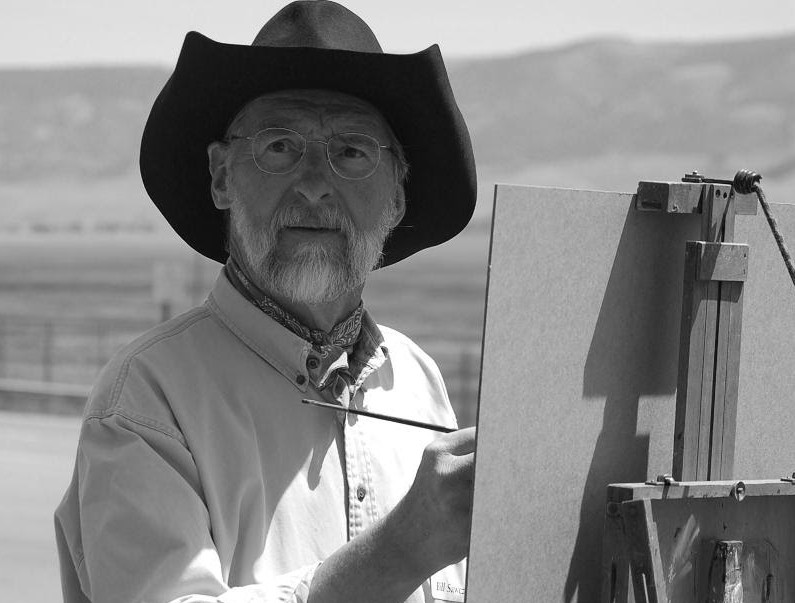
Bill and his french easel.
Three extended easel legs - check. Big rock and bungee - check.   Wait...Bill! Your canvas is backwards!!
Now you're ready.  Choose the size of canvas or board that you wish to work with and fasten it to the easel with those little L shaped hooks that loosen with a simple twist of a knurled knob. If you twist too hard, you'll knurl your fingers. I usually tie a trash bag to the easel and weigh it down with a rock (not with a Grand Teton National Park rock!) that you have brought along for that specific purpose or you will be chasing painty paper towels through the sagebrush.  Now it's time to start!  Wait, do you detect the wind kicking up?  This is not good.  The wind causes problems that we wish to avoid such as vibrations in the canvas and flying dust and debris.  If the wind continues to strengthen (between noon and 3 PM) it may even do the unthinkable and blow over the easel, resulting in trauma to the easel and extreme frustration on your part.  Painters have been known to lose their tempers and use bad words at this point.  But don't do it!  Calmly pick up your easel, clean your canvas or board, reattach it to the easel, and try to clean up any paint or solvents that may have stained the ground.  I should have mentioned earlier that your solvents or mediums should be covered until you are actually ready to paint!  Now is the time to prevent the easel from blowing over again. Weigh it down with a rock and use ropes or bungee cords to tie it  to a tree, your vehicle or a fence.  Watch out with those bungee cords as they might snap back and hit you in the face and you will want to use those bad words again. But don't do it.
 
© Bill Sawczuk.
Now you're ready.  First, you should get out your sketch pad.  It is wise to do a few sketches of your subject so that you can determine your composition.  The mountains will be a great subject today, just look at that color!  Look at the clouds above the mountains!  Wait, what about those old cabins? They would be great to paint!  Now you see some buffalo nearby, and they would be good subjects.  What about painting those aspen in their beautiful fall foliage?   You must make crucial decisions here because you can't paint it all .  Pick what you like the best and start your sketches. You should be ready to go after 3-4 sketches. Now comes that great feeling.  You get to make the first marks on that empty white surface........Here goes!  Wait, is it getting dark?  Forget the whole thing.  Pack it up and go home.
 
Kathryn takes Bill's advice to heart.

 
From the paintbrush trail,
Bill Sawczuk


Thursday, May 28, 2015

In Praise of Memory

It is very well to copy what one sees; it's much better to draw what one has retained in one's memory. It is a transformation in which imagination collaborates with memory. (Edgar Degas)


http://www.triofineart.com/635790/wonderment-july-8-25-2015/
Enlightened, © Jennifer L. Hoffman, 2015,
oil and cold wax on linen, 24x18 in.

Think of a moment that is etched in your memory.  Perhaps it is a moment from your childhood.  Maybe it's something from last week.  What is it that you remember about it?  Why is that moment recorded in your mind?  When I think of childhood memories, I flash back to when I was just two or three years old.  I was in bed in the same room with my baby brother.  The room was dark, with moonlight streaming in from the window.  I could see the baby in his crib, sleeping soundly, when a dragon lifted up out of the small hooked rug on the floor, flew over the crib and out the window.  I was sure the dragon had stolen my brother.  Of course this was a dream, one that I woke from shrieking in fear, but I remember it from a toddler's perspective, as a completely real experience.  I don't remember what the rug looked like, or what color the blankets were, or if there were curtains on the window.  What I do remember are the most significant bits that created my experience of that moment. 

In our memories, the details become soft around the edges.  Sometimes the details even change in our recollections.  But the most important essence, the most indispensable information is stored in our neural pathways.  In art, that distilled essence is the seed of an idea!

Being primarily a plein air painter, I usually paint what I see or at least an interpretation of it.  But sometimes I am gripped by a moment that is too fleeting to capture or too subtle/dark/bright to successfully photograph.  Perhaps inclement weather or other responsibilities prevent me from stopping to sketch or paint.  In those moments, my only option is to rely on my memory.  Trust me - I don't have a photographic memory (or even a moderately good one.  I write notes to myself to remember things, and then forget where I left the note)!  But my ability to recall the essence of my inspiration improves incrementally the more I do it. 

Kealia I, © Jennifer L. Hoffman, pastel on board, 12x12 in.


Some years back I participated in a plein air festival in Tucson.  A group of us went to Bear Canyon to paint one afternoon.  While opening my French easel, I managed to whack the back of my hand into a cactus and came away looking like I'd lost a fight with a porcupine.  That was the beginning of my painting session, followed by dropping a pile of pastels on the rocky desert ground, and ending with a downpour (spring monsoon season)!  As you might imagine, I was feeling less than confident about my efforts that day. Afterwards, while waiting on our dinner at a local restaurant, my friend Greg McHuron pushed a pen and a napkin across the table towards me.  Greg was one of the most knowledgeable and prolific artists I've ever known.  "Draw your composition," he said matter-of-factly.  I looked at him blankly.  "Which composition?"  "Draw what you painted today," he explained.  So I drew a thumbnail of what I remembered as the composition.  "Look!" he said, pointing at the saguaro in front of the mountains that I'd sketched on the napkin. "You've already improved on your idea!"  He was right: I had subtly shifted the main elements of my design into a better version of my original composition.  Without the distraction of a million compelling details in front of my eyes, that idea became my whole focus. 

Fireflies, ©Jennifer L. Hoffman, 2013, pastel on mounted
paper, 8x8 in (private collection).  This piece utilized
 a very blurry photo of a farmhouse near my childhood home
and my memory of fireflies coming out at dusk.
Greg did small memory sketches of compositions and ideas all the time throughout his career.  He encouraged me to do the same.  I have found this to be some of the most valuable advice I've received.  The more I practice, the more I lean on the knowledge I've accumulated from years in the field, and the more confident I am in that knowledge.  A great landscape painter and author of  Carlson's Guide to Landscape Painting, John F. Carlson was also a proponent of memory work. "If you train yourself in memory work, you fearlessly attack and rearrange your material, for you can retain your original impression."

Recently, on a family trip to Kaua'i, I witnessed the full moon rising as we drove by Kealia Beach.  The moist air and the clouds over the ocean were refracting the moonlight, and the scene was so subtle and glorious I could hardly breathe.  I was with my family after a long day of hiking, and even if I'd had the appropriate gear, no one would have had the stamina to wait for me to paint.  So I asked my husband to pull over, and we just watched the clouds drifting across the moon, the ocean rolling - trying to absorb the colors in the sky and how the moonlight danced on the waves.  It was so lovely, I didn't want it to end.  Later in my studio back in Jackson, I could hardly wait to try capturing the moment.  I made a drawing, two pastels, and a large oil, just playing with the elements that left the most impression.  What fun to relive it.

There are no crutches when working from memory.  But often, my memory paintings are the most satisfying to me, because they aren't bogged down by the "reality" of an idea.  Freed from unnecessary detail, they are truly about the essence of an idea. 

Want to give your memory a little workout?  I have a few suggestions to get you started.  If you're an artist, start by making a small drawing of the piece on which you most recently worked - no peeking!!  What are the main elements?  How do they relate to each other?  Afterwards, compare it with the original.  How has it changed?  What did you recall accurately?  Next, pay special attention while you're out for a walk or driving somewhere in your car.  As soon as you can, get out a sketchbook (or a napkin) and draw what you remember most.  Not an artist?  You can try it too - just make notes on paper about something you've recently seen or experienced.  What caught your eye?  What were the sounds, the smells, the light effects that compelled you?  Or try explaining it to someone else in a way that they can experience what you saw/smelled/felt/heard.  You may find your first few tries somewhat difficult, but if you keep it up, you'll find it easier and easier to capture a moment in your memory.  And that is a treat in itself.

http://www.triofineart.com
Enjoy the memories -
Jen

Saturday, May 2, 2015

A Day in the Life

Trio artists share how they would spend the ideal creative day. 

As the artists of Trio Fine Art described their "ideal creative days," it became apparent that being and feeling unplugged from technology, society, and everyday demands lay at the heart of our artists' inspiration. A chance to escape, to paint, to ponder - and share these experiences with others - these three talented artists take a moment to reflect on the special moments in their life in which they glean inspiration and motivation for doing what they do best.  

***  

6:30 AM | It's summer, and the days are long in the Wind River Range. Kathryn rises and starts the day with several Sun Salutations. These yoga moves get the kinks that happen from sleeping on the ground. A feel-good way to wake up! More awake, Kathryn gathers up her field easel to continue her study of the morning light. The cook starts the coffee back at camp, and Kathryn takes a break to grab her morning jolt of caffeine. When the painting is finished, she returns  to a hot breakfast at camp.
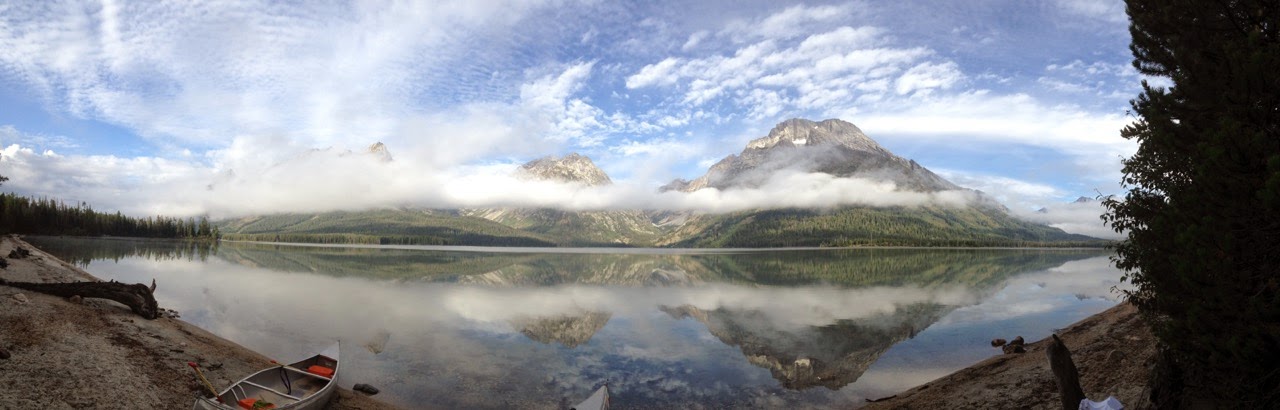
11:45 AM | After several hours of hiking, Kathryn finds herself high in the Green River Lakes area.
It is a clear summer day, and the light is vivid. She will spend the afternoon painting here.
2:30 PM | I am working on an afternoon painting that is informed by what I took in from my hike and sketches. The shadows are lengthening, and the colors are getting richer as the day goes by. It is a blue sky, but the high cumulus clouds slowly drift over the Mountains.
5:00 PM | The pack trip outfitters patiently wait as Kathryn puts the finishing touches on her paintings. They are packed away one a mule with the rest of the artists' materials to head back to camp. Appreciating the lighter load, Kathryn hikes back to camp, taking in the quiet and low light. Dinner is ready upon their arrival, and the artists and outfitters sit to enjoy a meal and each others' company around a dancing fire. As the stars start to appear, we feel uniquely blessed to be exactly where we are.

It feels like a luxury to be 'unplugged' from all this in the wilderness. In this solitude, I can best hear my artistic voice and intuition. - KMT

 ***

6:30 AM | The morning light finds Jen connecting with her husband, Ron, and daughter, Amelia. They share breakfast and discuss the day's plans. After walking Amelia to the bus stop, Jen takes a private moment to enjoy the sunshine on her favorite bench, writing and thinking about her art. Inspired and ready for the day, Jen packs up her painting gear and a lunch to head to Grand Teton National Park. She drives the Park road until she discovers her painting location for the day, exploring and reacting to the light. This is her favorite way to decide where and what to paint, focused and feeling like I am where I am supposed to be.
11:45 AM | Limited by the changing patterns in the light, Jen works for no more than one hour, one piece at a time, completing several sketches. Totally in my creative space... I lose track of time, completely at peace. Breaking for a brief lunch, Jen rests next to String Lake, enjoying her solitude. 
2:30 PM | Jen takes time to explore the far side of Leigh Lake by canoe as she waits for her family to arrive.
5:00 PM | Ron and Amelia prepare camp and dinner together, and Jen takes advantage of the waning afternoon light to capture her surroundings on the canvas. It's hard to give myself to the creative process when I feel compelled to take care of my family. But my family also gives me such joy that it feeds my creativity, and a trip like this is the perfect way to have it all! Camping by the lake, the three roast marshmallows and watch the stars together late into the night.


***

6:30 AM | A quick breakfast, and Bill sets off to his church to start the coffee and set up for Mass. After the service, he takes several canvases to a location North of town near the mountains to study the geometric shapes from the old buildings of the valley's ranches. The buildings provide contrast to the organic shapes of the landscape - this sets the picture off.
11:45 AM | Stopping to relax for awhile, Bill sets up a chair and admires his surroundings. Enjoying the day; feeling thankful.
2:30 PM | For the afternoon, Bill dives into a massive painting project on location - blocking in a 6 x 8 foot canvas! This image includes figures working in the landscape with the help of hired models. A rush of adrenaline and excitement working on a painting this size from life. He starts with two or three inch brushes to lay out a solid foundation of big, warm, dark, loose, bold brushstrokes that fall spontaneously into the right place!   
5:00 PM | Bill works as long as the light will hold, taking advantage of the immediacy of working from life. There is a sense of urgency that calls upon full concentration and commitment. He pays close attention to proportions, scale, and anatomy. Asking himself, What do I want to say, and how can I say it as simply as possible, he is thankful for the opportunity to experience and paint this scene, and to be able to share it with others through his work.


***

Make sure you take some time to 'unplug' as well.
All the best,

- Kathryn


 ___________________________________________________________________________

Save the Dates:

July 8th - 25th | Jennifer L. Hoffman's solo exhibition
July 29th - August 15th | Kathryn M. Turner's solo exhibition
August 19th - September 5th | Bill Sawczuk's solo exhibition